Conflux Docs
Routing

Smart routing

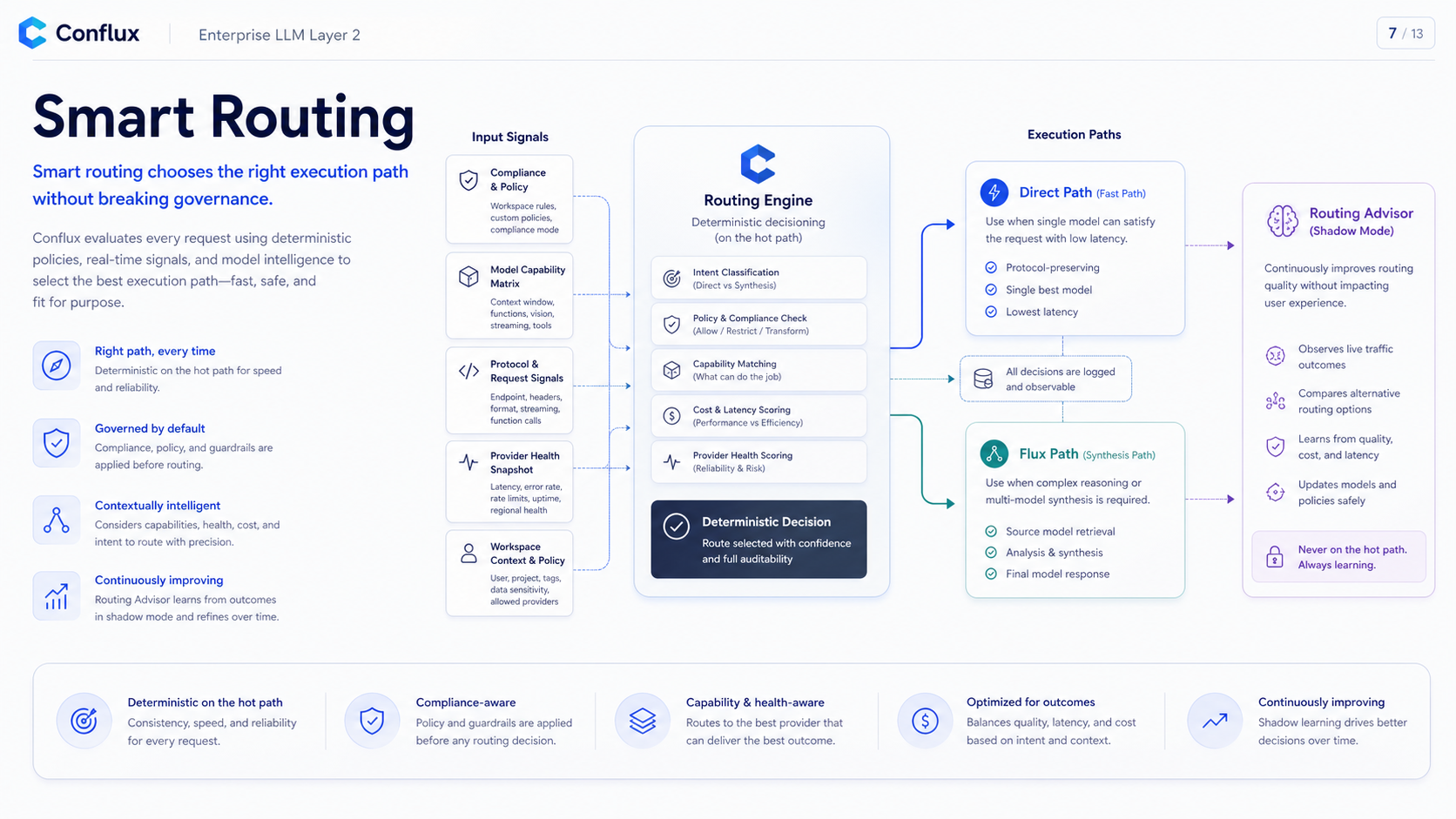
How Auto mode decides whether to stay Direct or use Flux.

Smart routing diagramClick to enlarge

Decision signals

Prompt intentAnalysis, architecture, risk, comparison, or ambiguous work pushes toward Flux.
Client profileCLI tool loops usually prefer low-latency Direct unless the task signals deeper reasoning.
Workspace policyAllowed models, provider constraints, compliance, and API key policy constrain routing.
Provider healthLatency and recent failures can affect route selection and fallback behavior.

Explicit routing

Users can signal intent with phrases like use flux or no flux. Conflux should interpret this as a routing instruction and avoid leaking routing control text into the downstream model prompt when it is clearly a system directive.

Fallback

If Flux fails in a recoverable way, Conflux can fall back to Direct when policy and protocol compatibility allow it. Provider 503 errors use retry/backoff on direct passthrough paths.