
Memory overview
How Conflux turns workspace activity into reusable knowledge.
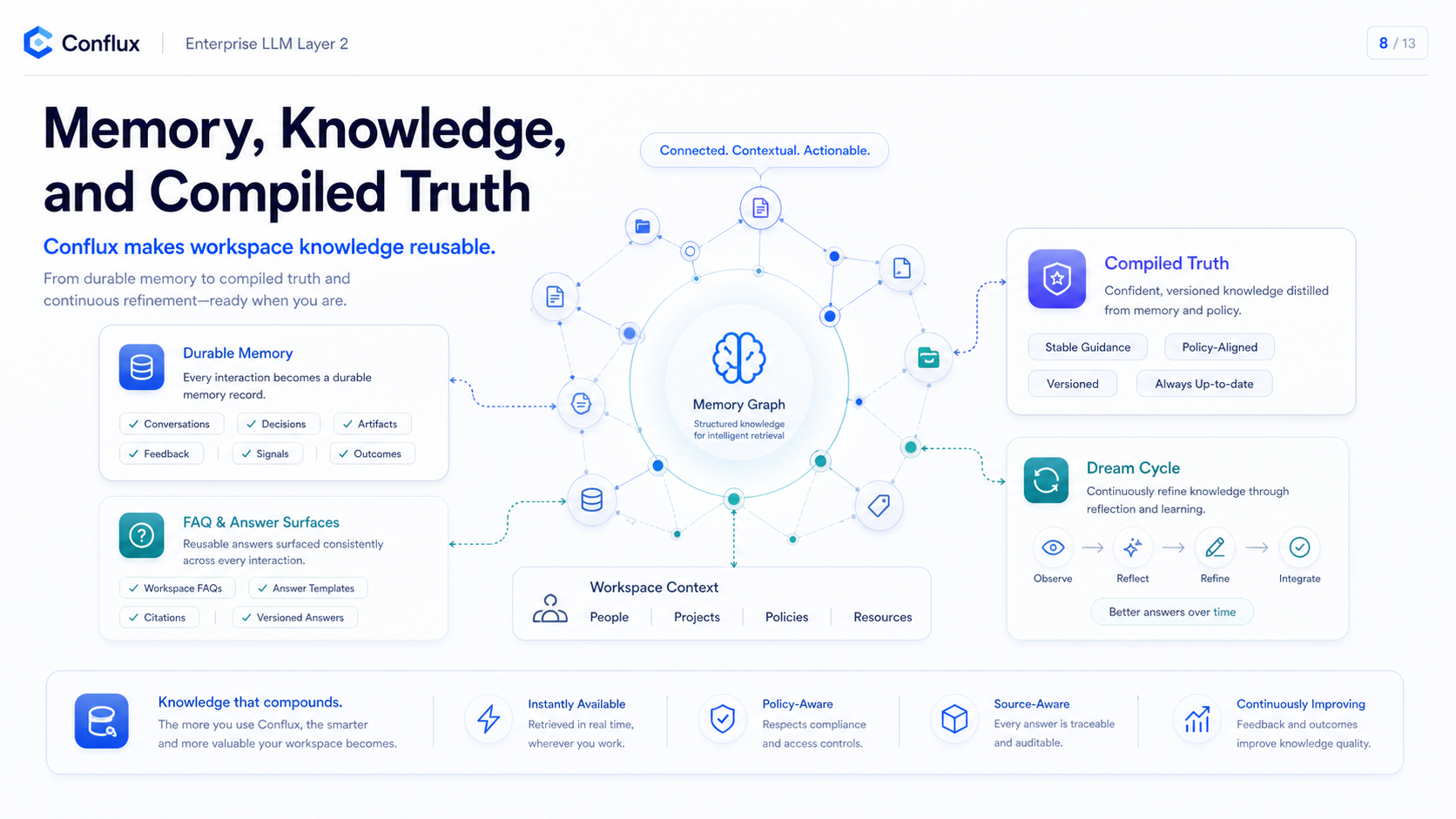 Click to enlarge
Not just chat history
Memory is designed to help a team continue work across people, sessions, clients, and time. It should know what was built, what was changed, what was decided, what remains uncertain, and what constraints matter.
Current implementation
Conflux currently stores durable memory records, hash-ngram memory embeddings, evidence citations, Dream Cycle lifecycle decisions, compiled truth, and graph links. Retrieval can inject relevant workspace memory, compiled truth, and FAQ context into a run. The current retrieval path is hybrid: multilingual lexical matching, vector-hash similarity, stored MemoryLink expansion, and compiled truth. It is graph-aware, but it is not yet a full A/B/C semantic graph with root/topic/entity nodes.
Evidence-backed memory
Memory can cite evidence such as prompts, assistant results, tool calls, file changes, CLI activity, API activity, optimized evidence views, user corrections, and compliance scans. This keeps memory inspectable rather than becoming an unverifiable summary.
Optimized evidence views
Long tool outputs and noisy logs can be reduced into compacted evidence views that preserve file paths, operations, errors, trace ids, diff anchors, and domain signals. These views support memory and citations, but they do not replace the final assistant answer as the primary source for request-chain memories.
What it stores
Target layered model
Known gap
The product direction is a semantic workspace knowledge graph. Today, Conflux has the storage and evidence foundation plus graph-aware retrieval v1, but first-class topic clustering, root workspace nodes, entity extraction, and LLM/embedding relation extraction are still being improved.